Wednesday, February 17, 2016

Do You Really Need Surgery To Relive Back Pain?


According to the Mayo Clinic, "back surgery is needed in only a small percentage of cases. Most back problems can be taken care of with nonsurgical treatments, such as anti-inflammatory medication, ice, heat, gentle massage and physical therapy." Accurate on face value, but missing an important piece of the puzzle.

 Yes, while back pain is rampant, surgery is rarely required; even the Mayo Clinic admits that while "back pain is extremely common ... surgery often fails to relieve it."

However, chiropractic is glaringly absent from the nonsurgical recommendations, despite ample research evidence supporting chiropractic care for back pain and increasing reliance on chiropractic as a first-line treatment option.

So, what determines whether a patient undergoes spinal surgery? A recent study attempted to answer that very question and came up with several predictive variables, perhaps the most interesting of which is the type of health care provider – namely a surgeon or a doctor of chiropractic – the back pain patient sees first.

 The study authors, who note that "there is little evidence spine surgery is associated with improved population outcomes, yet surgery rates have increased dramatically since the 1990s," found that Washington state workers with an occupational back injury who visited a surgeon (orthopedic, neuro or general) first were significantly more likely to receive spine surgery within three years (42.7 percent of workers) than workers whose first visit was to a doctor of chiropractic (only 1.5 percent of workers). This association held true even when controlling for injury severity and other measures.

back surgery - Copyright – Stock Photo / Register Mark Of the 174 workers (9.2 percent of the subject population) who had a surgery during the three-year time frame, the vast majority were decompression procedures (78.7 percent), with 3.4 percent undergoing fusion without decompression and 17.8 percent undergoing both on the same day.

Wednesday, February 3, 2016

How Neck Problems Can Trigger Headaches


More Americans complain about headaches than any other health condition, including back pain; in fact, approximately 45 million Americans say they suffer headaches each year. That's one in every six people or more than 16 percent of the population. More than 8 million Americans visit their doctor seeking relief for symptoms of headaches each year. Unfortunately, the most popular treatment is over-the-counter pain relievers or prescription medication.

There is some good news when it comes to headaches. There are safe and effective natural solutions available to help reduce or eliminate the symptoms of various headache types. For example, chiropractic treatment is a highly sought-after alternative treatment for the debilitating effects associated with headaches. Let's learn about that headache you may be suffering from and how chiropractic can help you get rid of it.

Headaches 101
Tension headaches: The most common type of headache is the tension headache. It is estimated that 80-90 percent of the U.S. population suffers from tension headaches at some point in their lives. There are two primary types of tension headaches:
  • Episodic: Headaches appear occasionally, usually less than 15 times per month.
  • Chronic: Headaches occur more than 15 times per month or on a consistent basis.
A Drug-Free Way to Treat Headaches - Copyright – Stock Photo / Register Mark Tension headaches are intimately connected to abnormal posture, muscular tightness, joint stiffness, and restricted range of motion in the body. To obtain optimum health and function, it is important to remember that everything is connected and everything matters. Dysfunctional patterns of movement and posture affect how much tension and stress your body holds. The body must compensate for these dysfunctional patterns by any means necessary, and it accomplishes this by altering tension points.

Muscles attach to anchor points on bone and act as primary movers and stabilizers for your body. Mover muscles are used get you from point A to point B, such as a getting up out of a chair. Stabilizer muscles control that movement so you don't fall down while standing up. Abnormal posture and altered tension points on bone anchors puts too much wear and tear on muscles and joints. Your brain and nervous system must compensate for this dysfunction by altering blood flow, muscle movement patterns and breathing. These alterations often lead to tension headaches.

Migraines: The second most common type of headache is the migraine headache. Approximately 16-17 percent of the population complains of migraines. These headaches are far more debilitating than the tension-type headaches. More women than men suffer from migraine headaches, leading researchers to believe there may be a hormonal component to migraines. The majority of migraine sufferers report some sort of trigger that kicks of their headaches (food, drink, smell, etc).

How Chiropractic Can Help
Chiropractic care can help alleviate the symptoms of tension and migraine headaches by improving and restoring normal postural patterns. Chiropractic treatment is aimed at normalizing muscle tension, restoring joint range of motion, and stabilizing the body to reduce abnormal stressors.

Optimizing postural control of the head and neck reduces the workload your muscles must apply just to keep your head up during the day. Proper spinal alignment and muscle control helps give the body a fighting chance of avoiding a tension headache.

Proper breathing is essential to relaxation, blood flow, and oxygen supply to the brain and body. Abnormal posture, which can include such dysfunctions as rounded shoulders, neck forward over the shoulders, slouched positions and tightness in the hips from sitting all day, decrease lung capacity. This decreased capacity alters how much you breathe, how often, and from where.

Headache sufferers tend to breathe more from their chest and shoulders as opposed to their diaphragm. This leads to repeated elevation of the shoulders and upper back muscles hundreds of times a day, leading to increased tension in the head and neck. Chiropractic restores function to the spine, ribs, and hips to maximize breathing and good postural control. Better breathing equals better health.

Wednesday, January 20, 2016

How Stress Can Cause Back (and Neck) Pain


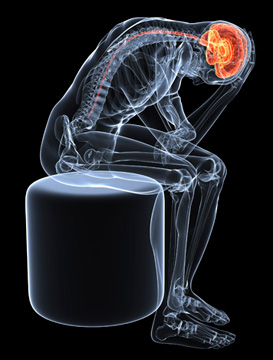
Stress is a part of life, and so is back pain. Ironically, stress is a leading cause of episodic back pain.

Your body experiences a cascade of physiological responses during chronic stress setting the stage for injury. The human body is genetically programmed to respond to stressful situations by stimulation in a survival part of your brain known as the limbic system. Otherwise known as the reptilian or primal brain, it is responsible for the emotional "flight or fight" (run or stand and fight) response to negative stimuli.

 Your brain response functions the same in stressful situations regardless of the source and extent of the threatening stimuli. The limbic brain does not recognize differences between types and degrees of stress. It simply reacts. Your body releases hormones (chemical messengers) which cause a physical reaction to stress; shortness of breath, sweating, increased heart rate, muscle tension, tightness or stiffness in joints, etc., in preparation for survival reaction.

So whether you are about to be chased by a rabid dog, cut off in traffic, or had a tough day at work the same response occurs. The same negative physical impact also occurs on the body.

 There are several different types of stress and learning how to control them can make all the difference. You have physical stress (lack of exercise, illness, sleep habits, etc), mental stress (how you deal emotionally with life) and chemical stress (nutritional and environmental).

Stress and Back Pain - Copyright – Stock Photo / Register Mark Stress alters breathing patterns by causing you to breathe more from the chest/lungs than the diaphragm. This altered pattern increases tension in the neck and upper back leading to poor posture, muscle tightness and headaches. The diaphragm is a dome shaped muscle that sits in the lower part of the ribcage underneath the lungs. Optimal breathing patterns should occur from the diaphragm first, followed by the lungs. Most often people have dysfunctional patterns where this sequence is reversed.

 Breathing is the foundation for relaxation. Learn to control your breathing and you will have discovered a secret weapon of relaxation and stress reduction. To check your breathing pattern lie on your back with knees bent. Close your eyes and place one hand on your abdomen and the other on your chest. Take a deep breath in through your nose. The lower hand should move first and the upper hand second. If the upper hand moves first you have an altered breathing pattern. Luckily it is fairly easy to learn how to breathe again properly. In our quick tip help guide below you will learn how to restore normal breathing patterns.

Stress increases tension in the body 24/7. It is like flipping the light switch on for self- protection, muscle tension and tightness. Think about how stiff and tight you feel when walking across ice. Your body tenses up in anticipation of falling and is trying to protect you from injury. Imagine how your muscles would feel if you were in this constant state of tension for weeks at a time. It would not feel good! That is what chronic stress is doing.

 Stress increases production of specific hormones known as cortisol and adrenaline located in the adrenal glands. These are two small glands that rest on top of the kidneys, one on either side. Cortisol is nicknamed the "stress hormone" and it can cause many negative reactions in the body if it is unbalanced. Chronically elevated levels of cortisol and adrenaline will cause increased inflammation in the body. In essence, your own body begins to turn on itself.

So what are some simple and effective tips you can start doing today to help alleviate stress? Below are suggestions for helping physical, mental and environmental stress in your life.

Nutrition: Eat healthy and eat often to control blood sugar levels. When you wait long periods between meals, you have a spike of a hormone known as insulin. This hormone controls how fast sugar enters your bloodstream after eating. Big surges in insulin occur when you wait too long between meals which may increase stress on your body chemistry. You can get cravings and mood swings. Eating only three meals a day is insufficient in keeping this delicate balance of hormones in check. It is recommended to eat three meals a day, mixed in with 2-3 healthy snacks. You will notice a renewed sense of energy and vitality with regular feedings.

Mental: Take some "me" time every morning before you start the day. Use this time to reflect on yesterday and plan out today's events. With the craziness of non-stop information overload in today's society it's more important than ever to take quiet moments. Set your alarm 15-minutes early and wake up to silence. Do not turn on the television or open the newspaper. You may find that problems which have plagued you suddenly become more manageable and put into perspective. When was the last time you sat in a room without white noise all around? Try it and see what happens.

Physical: Learning how to breathe with your diaphragm takes some practice, but in time it will become second nature. Practice the following technique on a daily basis for 3-5minutes. Lie on your back, putting a pillow support under your knees to relax your lower back. Place one hand on your abdomen and the other on your chest. Slowly inhale through your nose and make sure the only hand to move is the one on your abdomen. Try to keep the hand on your chest as still as possible. Exhale through pursed lips and repeat. You may become temporarily lightheaded after your first few, but this is a normal response to the increase in oxygen uptake by the body. Do this before bed time and you will have a more restful sleep leading increased recovery and regeneration.

You do have power over your body. Simple changes in your life to help reduce stress can have a profound impact on your health. Take back control of your life from pain. Empower yourself to feel good again mentally and physically. Start with the simple strategies above and when you feel the positive difference you will want more for yourself.

To decrease the stress in your life, talk to your chiropractor about your concerns.

Wednesday, January 6, 2016

Are You Suffering From the #1 Cause of Worldwide Disability?


Are you suffering from back or neck pain?

 You're definitely not alone, and we mean on a global scale. A series of studies emerging from the Global Burden of Disease 2010 Project, a massive collaboration between the World Health Organization, the Institute for Health Metrics and Evaluation, the University of Queensland School of Population Health, Harvard School of Public Health, Johns Hopkins Bloomberg School of Public Health, and the University of Tokyo, Imperial College London, clarifies the worldwide health burden of musculoskeletal conditions, particularly back and neck pain, in crystal-clear fashion, with low back pain identified as the number-one cause of disability worldwide and neck pain the number-four cause. Overall, musculoskeletal conditions represent the second leading cause of global disability.

Findings emphasize the shift in global health that has resulted from disability making an increasingly larger footprint on the burden of disease compared to a mere 20-30 years ago. In addition, while more people are living longer, the flip side is that they do so with an increasing risk of living with the burden of pain, disability and disease compared to generations past.

Dr. Scott Haldeman, a neurologist and doctor of chiropractic, provides a summary of the project's findings that should make it abundantly clear that conditions many people may consider relatively harmless actually have tremendous potential for long-term health consequences:
  • Musculoskeletal conditions such as low back pain, neck pain and arthritis affect more than 1.7 billion people worldwide and have a greater impact on the health of the world population (death and disability) than HIV/AIDS, tropical diseases including malaria, the forces of war and nature, and all neurological conditions combined. 
  • world epidemic - Copyright – Stock Photo / Register Mark When considering death and disability in the health equation, musculoskeletal disorders cause 21.3 percent of all years lived with disability (YLDs), second only to mental and behavioral disorders, which account for 22.7 percent of YLDs.
  • Musculoskeletal conditions represent the sixth leading cause of death and disability, with only cardiovascular and circulatory diseases, neonatal diseases, neoplasms, and mental and behavorial disorders accounting for more death and disability worldwide.
  • Low back pain is the most dominant musculoskeletal condition, accounting for nearly one-half of all musculoskeletal YLDs. Neck pain accounts for one-fifth of musculoskeletal YLDs.
  • Low back pain is the sixth most important contributor to the global disease burden (death and disability), and has a greater impact on global health than malaria, preterm birth complications, COPD, tuberculosis, diabetes or lung cancer.
  • When combined with neck pain (21st most important contributor to the global disease burden – death and disability), painful spinal disorders are second only to ischemic heart disease in terms of their impact on the global burden of disease. Spinal disorders have a greater impact than HIV/AIDS, malaria, lower respiratory infections, stroke, breast and lung cancer combined, Alzheimer's disease, diabetes, depression or traffic injuries.
  • Current estimates suggest that 632.045 million people worldwide suffer from low back pain and 332.049 million people worldwide suffer from neck pain.
"The Global Burden of Disease Study provides indisputable evidence that musculoskeletal conditions are an enormous and emerging problem in all parts of the world and need to be given the same priority for policy and resources as other major conditions like cancer, mental health and cardiovascular disease," said Dr. Haldeman.

The seven studies from Global Burden of Disease 2010, as well as accompanying commentaries, appear in The Lancet. And by the way, when it comes to preventing and treating musculoskeletal issues, particularly back and neck pain, chiropractic care has been shown in numerous research studies to be an effective conservative option.

Wednesday, November 25, 2015

How Commuting Effects Your Neck and Back Pain


Unless you're a work-at-home member of the labor force (which has its own health risks, by the way), most of us commute from home to work and back again at least five days a week. From a health perspective, research suggests commuting is bad news, and it goes beyond the stress associated with those bumper-to-bumper, road-rage meltdowns you find yourself experiencing ... but somehow think you can handle day after day, week after week, year after year.
 
According to several recent studies, commuting – particularly longer times spent commuting – has a negative impact on weight, blood pressure, sleep quality / amount and heart disease. One study suggested the longer the commute, the higher the commuter's body-mass index, waist circumference, diastolic and systolic blood pressure, and metabolic risk factors. Another study found that high blood pressure, stress and heart disease were more likely in people who commuted more than 30 miles a day. And in a third study, researchers concluded: "Commuting long distances negatively impacts one's ability to capture adequate sleep."

The Telecommuting Age isn't necessarily solving the commuting health crisis, either; after all, even as more people work from home, the population at large continues to do more driving and less transportation by other means (bikes, foot, etc.). More time in cars, less time exercising - another recipe for health disaster.

commute - Copyright – Stock Photo / Register Mark The solution, if there is one, is to find ways to make your commutes as short, stress-free and infrequent as possible. Here are a few suggestions:
  • Map it out: If there are multiple routes to your job, try some trial and error to determine which one gets you to and from work in the shortest – and least painful – amount of time.
  • Try 40 in 4: If your employer / state allows, ask about a possible four-day, 10-hour-a-day workweek option. You'll find that the 10 hours aren't a major drain, and you'll appreciate the extra day away from work – and out of the traffic jams.
  • Carpool: Yes, you're still spending time in a car, but at least you aren't always the one driving (and dealing with other drivers); and you're also not alone with your traffic frustrations, all of which contribute to stress.
  • Schedule it & stick to it: A likely explanation for why longer commutes lead to higher weight, etc., is not only that commuters sit in a car too long, but also that by the time they get home, they have little time – or perhaps interest – in exercising. Schedule in exercise before or after work and stick to the routine. It will help counter some of the effects of your commute, including stress.
For many people, commuting is a reality, and depending on the job opportunity and living situation, they can't change the distance to and from work. But that doesn't mean you're destined to a life in the slow lane and its debilitating health effects.

Wednesday, November 11, 2015

DC or MD: What's The Difference For Back Pain?


When you're suffering low back pain, shoulder pain or any number of similar musculoskeletal conditions, who gets the call: your medical doctor or your doctor of chiropractic? Your choice of health care provider in those situations could make a big difference, and research is continuing to prove it. According to the latest study, chiropractic care is at least as effective as medical care for certain musculoskeletal conditions, while reducing health care costs and leaving patients more satisfied with the results.

The authors of the study, published in the Journal of Manipulative and Physiological Therapeutics (JMPT), went so far as to state that for certain musculoskeletal conditions, visiting an MD first instead of a DC may actually be a mistake:

"The findings of this study support first-contact care provided by DCs as an alternative to first-contact care provided by MDs for a select number of musculoskeletal conditions. Restrictive models of care in which patients are required to contact a medical provider before consulting a chiropractic provider may be counterproductive for patients experiencing the musculoskeletal conditions investigated and possibly others."

easy - Copyright – Stock Photo / Register Mark The study sample included 403 patients who saw medical doctors and 316 patients who saw doctors of chiropractic as the initial health care providers for their spinal, hip or shoulder pain complaint. Four months following care, all patients completed a questionnaire that evaluated pain on that day and four months earlier (11-point scale); satisfaction with care received and the results of that care (5-point scale from "very satisfied" to "very unsatisfied"); and other variables. The researchers evaluated related costs of care by reviewing an insurance claims database.

"Patients initially consulting MDs had significantly less reduction in their numerical pain rating score and were significantly less likely to be satisfied with the care received and the outcome of care." What's more average per-patient costs over the four-month period were significantly lower in patients who initially consulted DCs ($368 difference compared to MD care).

JMPT Editor-in-Chief Claire Johnson, DC, MEd, emphasized the importance of the latest findings: "Comparative studies – in other words, research that compares the outcomes between two different providers or modalities – are rare for chiropractic care," she said. "Thus, this study ... is especially important if payers and policy-makers are to better understand the ‘triple aim' as it relates to chiropractic. Specifically, this study helps us better understand what type of care provides better patient satisfaction, is more cost effective, and improves population health."

The answer, suggests an increasing body of research, is chiropractic care.

Wednesday, October 14, 2015

How To Help Prevent Back & Neck Pain


Your spine is the backbone of your entire body – literally and figuratively. That means poor spine health can negatively impact you from head to toe. How can you keep your spine in shape? Let's learn more about this critical anatomical structure and take a look at some of the simple strategies you can employ to ensure a healthy spine and a healthy body.

Exercises (to Do and Not to Do):
 Since we're talking shape here, let's start with a few exercises that help promote spinal health in the form of proper posture – along with a few that promote poor posture and put the spine at risk. First, a strong core supports the spine, whereas a weak core can lead to pain and injury. To build the core, think planks, bent-leg knee raises, stability ball exercises, ab curls, medicine ball slams and other exercises that strengthen the core muscles (remembering to keep your spine protected at all times by avoiding rounding the back / neck). On the other hand, avoid exercises / movements that unduly stress the spine: slumping while sitting and bending forward immediately after sitting come to mind, as do exercises that make you prone to rounding your back (traditional sit-ups, toe-touches, etc.).

Sleep Matters:
 Your sleep position and the overall quality of your sleep play a big role in spinal health. The ideal position for the spine during sleep places you on your back with a pillow between your legs. As you might imagine, lying on your stomach is the worse position. Your pillow and mattress also matter, so make sure you choose the right ones for you, or your spine will let you know with neck and/or back pain. (Talk to your chiropractor for suggestions.)

healthy spine - Copyright – Stock Photo / Register Mark Nutrition Essentials:
 Believe it or not, certain foods promote a healthy spine (and vice versa). For example, adequate water intake is necessary to nourish not only the body's cells, but also the spinal intervertebral discs, which consist primarily of water at birth. As you might imagine, water helps keep the discs (and thus the spine) from getting stiff and subject to injury.  In addition, an anti-inflammatory diet is key to preventing back pain and other spine problems due to inflammation. Think foods such as omega-3 fish and lean proteins, fresh produce, avocado, olive oil, and various spices while reducing intake of pro-inflammatory foods (most fast foods and processed foods, sugar-laden sweets, etc.).

Chiropractic Care:
 No conversation about spine health would be complete without mentioning chiropractic, an entire health care profession founded on the principle that a healthy, properly aligned spine has far-reaching effects on the entire body. Research asserts chiropractic's effectiveness in treating back pain, neck pain and various other musculoskeletal conditions, and the goal of periodic chiropractic care is to maintain spinal health, optimize the body's self-healing capacities, and thus prevent pain from returning. If you haven't been to a chiropractor yet, what are you waiting for? If you've visited one, but haven't returned in awhile, remember: your spine – and your entire body – deserve it.